Home
About Us
Products
Process Models
SE Resources
Commentary
Contact us
|
|
|
Breaking News!
A new blog ...
Baremo De Honorarios Colegio De Abogados De Galicia Best //free\\ Online
Not immediately, but you should ask why. If they propose a fair fixed fee or transparent hourly rate, that’s fine. If they refuse any written cost estimate or reference point, that’s a red flag.
To ensure complete transparency regarding the cost of your legal proceedings, we base our fee structure on the official .
In conclusion, the search for a single "best baremo de honorarios" in Galicia is a search for a document that no longer exists in its traditional form. The "best" approach to legal fees in Galicia today is to . baremo de honorarios colegio de abogados de galicia best
While lawyers are free to set their own rates, they often align with guidelines set by their specific provincial college. Galicia is divided into several Bar Associations: ICA Coruña : Often follows the latest DOG (Diario Oficial de Galicia) updates for legal aid modules. ICA Santiago
5. Mejores Prácticas al contratar un abogado (Baremo y Hoja de Encargo) Not immediately, but you should ask why
But what does "best" mean when referring to this baremo? Is it the highest fee? The most updated? Or the fairest for both parties? If you are searching for the , you likely want the most reliable, legally recognized, and ethically sound guide to calculate legal costs. This article will dissect the official fee guidelines, explain why they are considered the benchmark, and how to use them to find the best balance between quality service and reasonable cost.
Remember that attorneys in Galicia are free to set their own rates based on complexity, time, and expertise. To ensure complete transparency regarding the cost of
This public link is valid for 7 days and shares a thread, including any personal information you added. This link or copies made by others cannot be deleted. If you share with third parties, their policies apply. Can’t copy the link right now. Try again later. Baremo de honorarios dos Colexios de Abogados de Galicia |
|
|
|
|
|
|
|
|
|
|
|
|
|
|
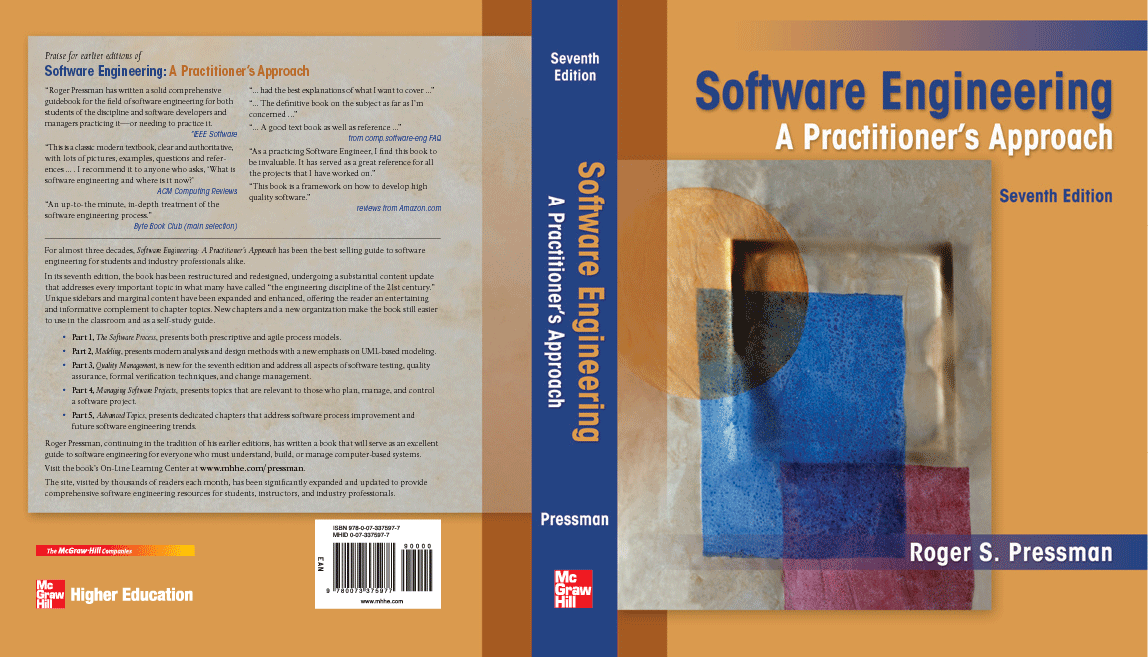
| The newest edition! |
|
 |
Another novel by
Roger Pressman! |
|
 |
|
|
|
|
|
Available in trade paperback and e-book editions. For more information, click here. |
|
|
|
|
|
|
|
|
|
|
The seventh edition of Software Engineering: A Practitioner's Approach is intended to serve as a guide to a maturing engineering discipline. The seventh edition, like the six editions that preceded it, is intended for both students and practitioners, retaining its appeal as a guide to the industry professional and a comprehensive introduction to the student at the upper level undergraduate or first year graduate level.
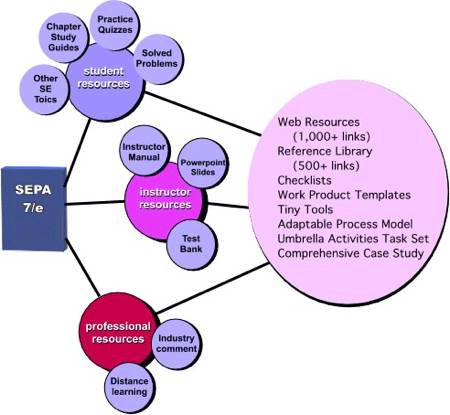
The seventh edition is considerably more than a simple update. The book has been revised and restructured to improve pedagogical flow and emphasize new and important software engineering processes and practices. In addition, a revised and updated “support system,” illustrated below, provides a comprehensive set of student, instructor, and professional resources to complement the content of the book.
|
|
|
|
 |
|
|
The 32 chapters of the seventh edition have been reorganized into five parts. This organization, which differs considerably from the sixth edition, has been done to better compartmentalize topics and assist instructors who may not have the time to complete the entire book in one term.
Part 1, The Process, presents a variety of different views of software process, considering all important process models and addressing the debate between prescriptive and agile process philosophies. Part 2, Modeling, presents analysis and design methods with an emphasis on object-oriented techniques and UML modeling. Pattern-based design and design for Web applications are also considered. Part 3, Quality Management, presents the concepts, procedures, techniques, and methods that enable a software team to assess software quality, review software engineering work products, conduct SQA procedures, and apply an effective testing strategy and tactics. In addition, formal modeling and verification methods are also considered. Part 4, Managing Software Projects, presents topics that are relevant to those who plan, manage, and control a software development project. Part 5, Advanced Topics, considers software process improvement and software engineering trends. Continuing in the tradition of past editions, a series of sidebars is used throughout the book to present the trials and tribulations of a (fictional) software team and to provide supplementary materials about methods and tools that are relevant to chapter topics. Two new appendices provide brief tutorials on UML and object-oriented thinking for those who may be unfamiliar with these important topics.
The five-part organization of the seventh edition enables an instructor to "cluster" topics based on available time and student need. An entire one-term course can be built around one or more of the five parts. A software engineering survey course would select chapters from all five parts. A software engineering course that emphasizes analysis and design would select topics from Parts 1 and 2. A testing-oriented software engineering course would select topics from Parts 1 and 3, with a brief foray into Part 2. A "management course" would stress Parts 1 and 4. By organizing the seventh edition in this way, I have attempted to provide an instructor with a number of teaching options. |
|
|
Software Engineering: A Practitioner's Approach
7th Edition
Table of Contents
Chapters
1. Software and Software Engineering
Part I - Process
2. Process Models
3. Agile Development
Part II - Modeling
4. Practice: A Generic View
5. Understanding Requirements (new chapter)
6. Requirements Modeling: Scenarios and Data (new chapter)
7. Requirements Modeling: Flow, Classes, and Behavior (new chapter)
8. Design Concepts (new chapter)
9. Architectural Design
10. Component-Level Design
11. Usability design (new chapter)
12. Pattern-based Design (new chapter)
13. WebApp Design
Part III - Quality Management
14. Quality Concepts (new chapter)
15. Software reviews (new chapter)
16. Software Quality Assurance
17. Software Testing Strategies
18. Testing Methods for Conventional Software (new chapter)
19. Testing Methods for OO Software (new chapter)
20. Testing Methods for WebApps
21. Advanced Verification Methods (new chapter)
22. Software Configuration Management
23. Product Metrics
Part IV - Project Management
24. Management Concepts
25. Process and Project Metrics
26. Estimation
27. Scheduling
28. Risk Management
29. Maintenance and Reengineering (new chapter)
Part V-Advanced Topics
30. Software Process improvement (new chapter)
31. Emerging Trends in Software Engineering (new chapter)
32. The Road Ahead
Appendix I - UML Tutorial (new)
Appendix II - OO Concepts (new)
|
|
|
|
|
|
|
|
|
Home About us Products Product Models SE Resources Commentary Contact us
Web site and all contents © 2001-2009, R.S. Pressman & Associates, Inc., All rights reserved.
Free website templates
|
|